Understanding Jericho history through its places
Jericho history becomes easier to understand when the places are separated on the ground. Tell es-Sultan represents the early settlement; the later palace landscape at Tulul Abu al-Alayiq belongs to another setting; and the modern city occupies its own area. Jericho lies in the Jordan Valley in the West Bank. Reading its past as a sequence of places gives more meaning to a visit than treating every ruin as part of one unchanged city.
The Palestinian tourism ministry distinguishes the early Tell, the later settlement associated with Herod's palace and the shift towards the present urban area in late Roman and Byzantine times. Use those locations as the framework for the day. Begin with the early settlement and its spring, then choose whether your interest leads towards later architecture or the religious landscape around the city.

Tell es-Sultan and the spring of Ain es-Sultan
UNESCO inscribed Ancient Jericho/Tell es-Sultan on the World Heritage List in 2023. The property includes the Tell and the adjacent permanent spring of Ain es-Sultan. Its significance concerns the early settlement and the evidence preserved there. The designation belongs to this property, so distinguish it from the later palaces and the modern streets when choosing what to visit.
UNESCO describes deposits of human activity from about 10,500 BC and a substantial permanent settlement in the ninth and eighth millennia BC, with a wall, ditch and tower. These features make the site a place to consider early community life and the organisation of a settlement. The spring belongs in that picture alongside the built remains. Look at the relationship between water, settlement and construction rather than expecting a single monument to explain the whole past.
For a planned Tell visit, arrange the current access details before setting the day's schedule. Ask about admission arrangements for the intended date. An itinerary can then give the ancient settlement its own place instead of leaving it as a brief addition to a much wider circuit. The Jericho excursions page compares other combinations if the day also needs to include more destinations.
Visit Jericho’s historic sites
This guided trip includes Jericho’s ruins and spring with transport from Tel Aviv.
Hand-picked tours, booked through GetYourGuide. Prices are indicative starting prices in US dollars (as of November 2026). Tap a tour for live availability and the current price in your currency.

A guided day with ancient Jericho
The Tel Aviv departure visits Jericho's ruins and spring with a professional guide, entrance fees and hotel transport. The mountain element is a view rather than a cable car ascent.
Later settlement, Herod's palace and the Umayyad complex
The later settlement at Tulul Abu al-Alayiq, associated with Herod's palace, is a separate historical place from Tell es-Sultan. The tourism ministry's account then follows settlement towards today's urban area in late Roman and Byzantine times. This change of location matters when interpreting the phrase ancient Jericho: different parts of the story belong to different places.
The Hisham's Palace complex adds an early Islamic chapter. The ministry dates the Umayyad complex to the eighth century and describes a palace, mosque, fountain and bathhouse. Mosaics in the large hall and diwan give this later site a different focus from the early settlement remains. Choose it for art and architecture rather than expecting another view of the same ancient buildings.
Biblical associations form a separate way of engaging with the landscape. Presenting them as religious tradition allows the stories to be understood on their own terms while the excavated remains are considered as archaeology. The Mount of Temptation guide follows the Christian tradition associated with Jesus fasting and explains the difference between the mountain view and a monastery visit.
Wadi Qelt and St George's Monastery in the historical landscape
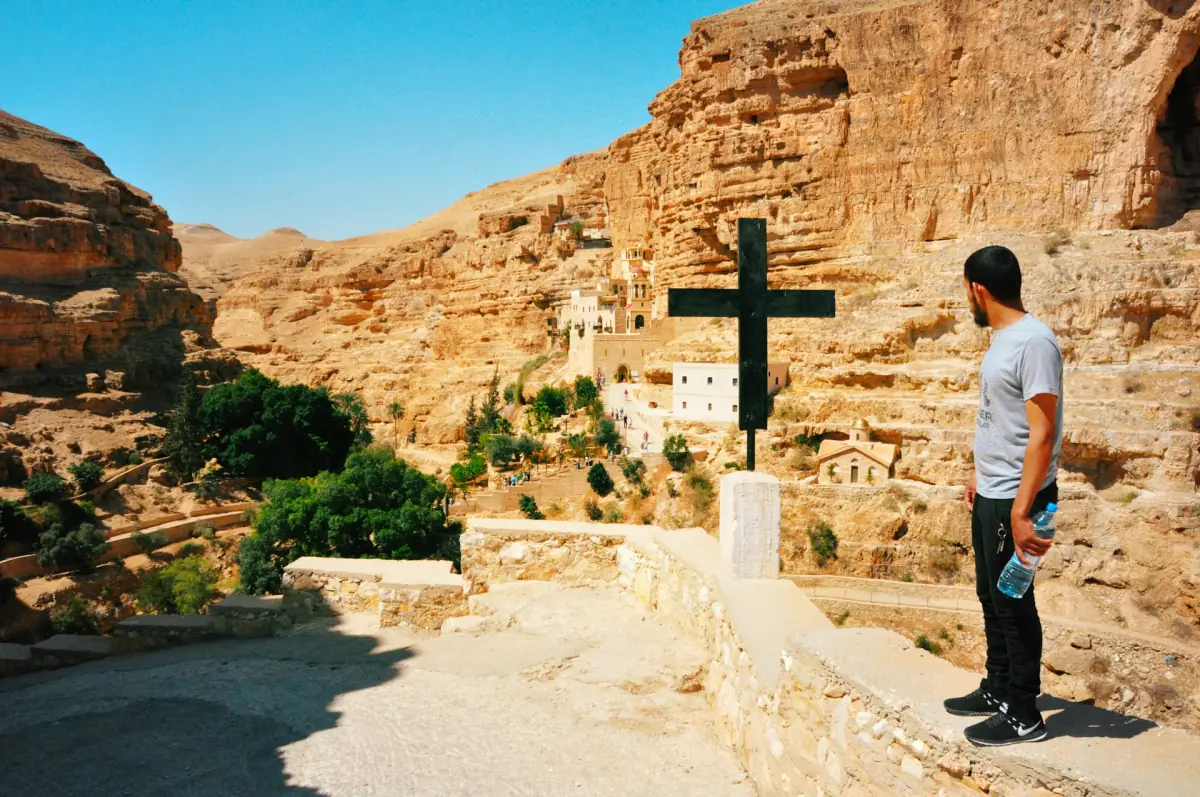
Wadi Qelt adds context to the old connection between Jerusalem and Jericho. The tourism ministry describes the Greek Orthodox Monastery of St George, also called Deir al-Qilt, as built into the rocks beside the wadi. Its setting helps explain why the surrounding landscape belongs in a wider account of Jericho's religious history.
Keep that historical context separate from the guided day offered here. The 12-hour excursion from Tel Aviv includes Jericho's ruins, the spring and a mountain view, with a professional guide, entrance fees, air-conditioned bus transport and hotel pickup and drop-off. Food and drink are extra. Choose it for its stated Jericho visits, and arrange any separate monastery interest on its own terms.
For the journey, read getting to Jericho and check current official travel advice before departure. This guide uses the German Foreign Office reference dated 9 November 2026, unchanged since 29 October, and the FCDO update of 27 October 2026. Let the access arrangements for the intended day shape the practical itinerary.
Questions about ancient Jericho
What is the UNESCO property?
Ancient Jericho/Tell es-Sultan was inscribed in 2023. The property includes the Tell and the adjacent permanent spring. Keep that designation specific when distinguishing it from the modern city and later palace sites.
Is Hisham's Palace part of the same early settlement?
It represents a later, Umayyad chapter from the eighth century. Its mosaics, bathhouse, mosque and fountain make it a separate architectural destination. Tell es-Sultan is the focus for the much earlier settlement story.
How should a Tell visit be planned?
Arrange access and admission details for the intended date before fixing the itinerary. Then choose whether to concentrate on archaeology or combine it with another Jericho site. The practical choice should follow the places you want to understand.